Wednesday, January 4, 2012

Fort Foote: Columbiads on the Potomac

Last Sunday (New Year’s Day), after a bit of breakfast, we drove out to Maryland and spent an hour or so exploring another fort in the Washington Defenses, Fort Foote.

Unlike Fort Ward, Fort Foote is one of the official “Fort Circle Parks”
maintained by the National Park Service.
In the first year of the war, the War Department was primarily afraid of possible overland assaults, particularly from Virginia, so the early forts were built to command the high hills in the region (such as Fort Ward) and to control access to the bridges into Washington (such as Fort Marcy, guarding the Chain Bridge).

But in early 1862, after the ironclad CSS Virginia sank two Union gunships on March 8, Washington suddenly looked very vulnerable to naval assault from the Potomac. Even after seizing Gosport Naval Yard (which ended the ability of the South to build more ironclads), the possibility of intervention by Great Britain (and her formidable navy) in the Confederacy’s favor was considered a real and serious threat.

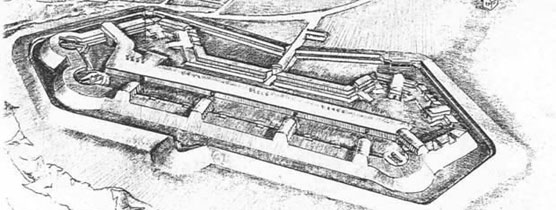
To protect Washington from such an attack, the War Department built a large artillery battery on Rosiers Bluff, a 100-foot-high cliff on the Maryland side of the Potomac River, about 6 miles downriver from Washington. This fort would serve as the chief defense of the Potomac River, supported by Battery Rodgers, a smaller battery situated on the Virginia side of the river at Jones Point in Alexandria.

Drawing of Fort Foote. Courtesy of Wikipedia.
The Maryland fort was completed in August 1863 and named after the late Admiral Andrew H. Foote, former commander of the South Atlantic Blockading Squadron. Foote had commanded the armored riverboats that pounded Fort Donelson from the Cumberland River in February 1862, but he was badly wounded in that battle and died of complications on June 26, 1863.

Fort Foote was equipped with twelve heavy guns, including six 30-pounder Parrott Rifles, four 200-pounder Parrott Rifles, and (most notably) two Model 1861 U.S. 15-inch Columbiads, commonly called "Rodman guns." This model was the largest cannon used in the Civil War, named after Brig. Gen. Thomas J. Rodman, whose manufacturing innovations (the "wet chill process") made it possible to produce guns of this size.  

Model 1861 U.S. 15-inch Columbiad
(The Rodman Gun)
Today, Fort Foote Park still has the two Rodman guns, which continue to loom over the Potomac River as they did 150 years ago.

A well trained team of 12 men could charge, load, aim, and fire
the Rodman gun once every four minutes.

The original fort was built with a mix of earth and timber. The wall that faced the Potomac was 500 feet long and 20 feet thick. Today, much of the original earthworks are still intact (and covered with woods).
Earthworks, Fort Foote
The two Columbiads at Fort Foote (along with a third Columbiad at Battery Rodgers) were the largest guns defending Washington, far larger than any guns in the inland forts, because of the potential need to repel an assault by ironclad vessels. The smoothbore cannons were not terribly accurate, but they had a range of three miles and could be loaded and fired once every four minutes.    

These smoothbore cannons weighed 25 tons and required 40 pounds of powder
to send a 440-pound round-shot over 5000 yards.
The guns were large enough to be considered a novelty by the Washington community. Large crowds of civilian and military observers gathered to watch the guns fire on February 27 and April 1, 1864. And even though they haven't been fired in over a century, the Columbiads continue to impress the locals.  

Our photographer is impressed by the Columbiads.

Tuesday, January 3, 2012

Cold Day on the Accotink

Just a quick post today.

As luck would have it, my office is very close to Lake Accotink Park in Springfield, Virginia, and I often spend my lunch breaks there. Earlier today, as I was leaving the park, we had a sudden snow flurry. It all vanished within 30 minutes, but I was able to enjoy a few peaceful minutes on the trail before returning to my office.


Lake Accotink is a minor Civil War site (complete with Civil War Trails interpretive signage). The park area includes the trestle where the Orange & Alexandria Railroad crossed the Accotink Creek. The longest continuous stretch of the old Orange & Alexandria line runs through Lake Accotink Park.

This foot trail was built on the original rail bed
of the Orange & Alexandria Railroad.
After Union troops occupied Fairfax Station, the O&A line became a popular target for Confederate sabotage. Most notably, JEB Stuart dispatched twelve men under the command of Gen. Fitzhugh Lee (nephew of Marse Robert) to burn the bridge over Accotink Creek during his raid on nearby Burke Station (December 28, 1862).


Aside from it's historical significance, Lake Accotink is a lovely park, and I frequently sneak out there with a quick lunch and a history book.

Monday, January 2, 2012

The Occupation Begins: A Visit to Fort Ward

Yesterday I described the occupation of Alexandria by federal troops because that is my primary theme for this blog; the history of Alexandria and North Virginia during the Civil War. But I also did it to provide some back story for our recent trip to Fort Ward.

The reconstructed front gate of Fort Ward,
based on the original design by the Army Corps of Engineers.
Fort Ward was one of the 68 forts built to protect Washington from invasion by Confederate forces during the Civil War. It was the fifth largest fort in the defenses of Washington, and is considered the best preserved of the surviving forts, with about 90% of its earthworks intact. Of the four forts built within Alexandria, Fort Ward is the only one that still exists. The fort is now part of the Fort Ward Museum and Historic Site, maintained by the City of Alexandria, which also includes a museum that offers rotating exhibits on Civil War subjects.

For a limited time, the Fort Ward Museum & Historic Site is showcasing an exhibit on the Union occupation of Alexandria and Marshall House Incident. So we drove up there last Friday to review the exhibit and take some pictures. A perfect start for a blog about the Civil War history of Alexandria.

In fact, we thought the exhibit was closing at year's end, but it was a false alarm: The Site's Director informed us that, due to its popularity, the exhibit will be held over at least through February 2012. I urge all local Civil War enthusiasts to see it while you can.

The exhibit includes some excellent artifacts relating to the Alexandria Occupation and the Marshall House Incident. The exhibit is fairly small, but they have some genuine gems, including a fragment of the Marshall House Flag stained with Ellsworth's blood, and Col. Ellsworth red kepi.

A fragment of the Marshall House Flag, stained with Ellsworth's blood.

Col. Ellsworth's red kepi, given by his family to Capt. Edwin M. Coates.
As luck would have it, the museum was fairly quiet last Friday, and the Site's Director, Susan Cumbey, was kind enough to share some fascinating stories about how the museum came to possess some of its best items, including the flag fragment and the kepi.

Both of these items were donated to the museum by retired Army colonel Charles Coates, the grandson of Capt. Edwin M. Coates of the 11th New York Zouaves. Capt. Coates was a friend of Ellsworth, and was given the kepi by Ellsworth’s family. According to Ms. Cumbey, Charles Coates claimed the kepi had been framed by his grandfather, pressed flat and hanging over a fireplace for decades. Consequently, the hat required some restorative work before it was fit to present in the museum.

Many thanks to the very knowledgeable Susan Cumbey To see Ms. Cumbey at work, check out this short clip from December 2010, courtesy of C-SPAN 3.

I also want to thank my staff photographer, Grace Malone, for her assistance and boundless enthusiasm.

Grace is a big fan of interpretive signage.
I'm quite fond of the Civil War Defenses of Washington, and in the weeks ahead, I plan to visit more of the "Fort Circle Parks" and discuss them here.

Sunday, January 1, 2012

The Occupation Begins: The Marshall House Incident

What better way to launch a blog about Alexandria's Civil War history than with a discussion of the occupation of Alexandria by federal troops in the early days of the war and the famously fatal exchange between Elmer Ellsworth and James Jackson at the Marshall House hotel?

By the time of the Fort Sumter crisis in April 1861, seven Southern states had seceded from the Union, but not Virginia. Her loyalties were still undecided. While very few Virginians supported Lincoln and the Republicans, many considered secession too rash and pressed for a peaceful solution to the crisis. But after Sumter, the debate effectively ended. Just three days after the fort surrendered, on April 17, the Virginia Secession Convention passed its Ordinance of Secession, to widespread public approval.

That same afternoon, one particularly enthusiastic secession advocate, James W. Jackson, attracted a large crowd on the corner of King and Pitt Streets by hoisting a large Confederate flag from the roof of the Marshall House hotel. He had only owned the hotel since January, but his loyalties were well known. The flag was massive, 14-foot-by-24-foot, large enough to be visible from the White House, and Jackson publicly claimed that "whoever should attempt to remove it, would have to pass over his dead body."

To be ratified, the Ordinance of Secession required a statewide popular vote, scheduled for May 23. On the day of the vote, by Lincoln's order, a force of 10,000 federal troops (volunteer regiments from New York, New Jersey and Michigan) assembled in the District and prepared for a military incursion into Virginia. The voters of Virginia passed the Secession Ordinance by a margin of 3 to 1. (In Alexandria, the margin was almost 9 to 1.) That night, at about 1:30 AM on the morning of May 24, federal troops began marching across the Long Bridge from D.C. into Virginia. At the same time, other regiments crossed the Potomac by way of the Aqueduct Bridge (one mile to the north) and by boat.

Courtesy of Wikipedia
One of the regiments crossing by boat was the 11th New York Volunteer Infantry, the "First Fire Zouaves," led by Col. Elmer E. Ellsworth. Just 24 years old, a native of New York, Ellsworth was a friend of President Lincoln, who had personally asked Ellsworth in April to help raise a regiment to defend the Capitol. To fulfill his commission, Ellsworth had recruited men from the New York volunteer fire companies (thus the nickname "Fire Zouaves").

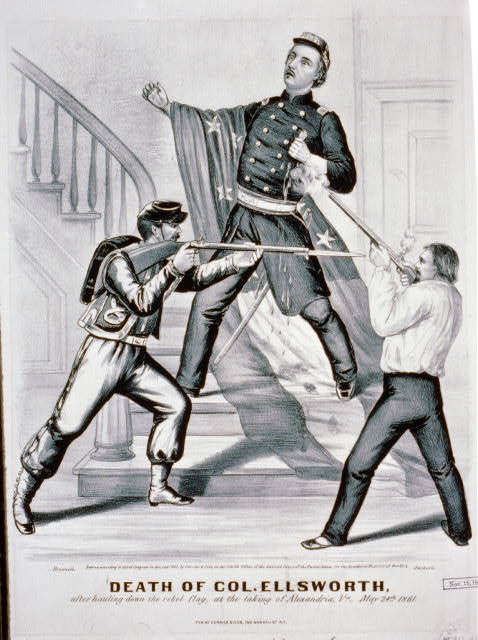
By dawn, most of the Alexandria militias had evacuated the city, federal troops were securing the vital Orange & Alexandria Railroad depot, and Ellsworth was leading his regiment to secure the telegraph station. As they marched through the city, Ellsworth noticed the great Confederate flag flying over the Marshall House, and decided to remove it. Accompanied by four of his troops, he burst through the doors of the three-story hotel, marched to the top floor, and pulled down the huge flag.

As he descended the stairs, flag in hand, James W. Jackson met them at the third floor landing and shot Ellsworth in the chest with an English-made double-barreled shotgun. Ellsworth was killed instantly, and in retaliation, his fellow Zouave Corporal Francis E. Brownell immediately shot Jackson in the face with a .58 caliber percussion rifle.

Courtesy of Wikipedia
So it was that, on the first day of the occupation of Alexandria, Col. Elmer Ellsworth became the first Union officer killed in the Civil War. Both men quickly became celebrated martyrs by their respective sides. Lincoln ordered an honor guard to bring his friend's body back to the White House, where he lay in state in the East Room. Eventually, Ellsworth's body was returned to New York and buried in his hometown of Mechanicville, in the Hudson View Cemetery.

Alexandria would remain an occupied city, under a state of martial law, for the duration of the Civil War, longer than any other community in the Confederacy.

Tomorrow I will discuss our recent visit to the Fort Ward Museum & Historic Site, which is currently hosting an exhibition on the Marshall House Incident, and I will post photos of some of the more interesting artifacts.

Saturday, December 31, 2011

Another Civil War Blog?

Yes, I know; I'll be the first one to admit, the world does not need another Civil War blog. We already have plenty of excellent blogs to choose from, written by people who do actual research and contribute more than just summarized descriptions of well-known battles. So what do I have to offer to the historical community?

Probably not much. My motives are admittedly very personal. I have only been studying the Civil War for the past year, and I do not pretend to be an expert.

About 11 years ago, I moved to the city of Alexandria, Virginia. I moved here for a good job, and nothing else. I had no friends or family in the area (other than a supportive aunt in Hampton Roads). Had my luck been slightly different, I may well have spent the last 11 years in Tallahassee, FL or Newport News, VA. As it happens, I was offered a tech writing job with good pay in Springfield, VA. And quite by accident, I hastily moved into an apartment in a high-rise in nearby Alexandria.

Little did I know, I was moving into a city that is saturated with vivid history. Alexandria is more than just a suburb of D.C. It is one of the oldest communities in the country, and its citizens have witnessed some of America's most tumultuous crises, including the American Civil War.

But I didn't know any of that in Summer 2000. While I was impressed by the mystique of Washington itself, I knew little of the history of Alexandria or the other communities surrounding D.C. The little I did know mostly related to the Revolutionary War era and George Washington. And I knew nothing - absolutely nothing - about the impact of the Civil War on the area. And for 10 years, I lived in this city without appreciating or investigating its rich history.

But things change. About six years ago, I developed an interest in the American Revolution. I'm not too proud to admit, it was David McCullough's fault. On a lark, I picked up a copy of 1776 (after seeing an intriguing interview with McCullough on The Daily Show) and was absolutely fascinated by it. By the time HBO aired the John Adams mini-series in 2008, I was fully primed for it. A few months later, I visited Philadelphia and saw some of the primary sites (Independence Hall, the Constitution Center, the obligatory stuff). Since then, the early history of America has been a major passion of mine.

Still, it took me a while to get to the Civil War. I spent about two years focusing exclusively on the Federalist Period, the first 12 years of the American republic. Truly a fascinating period, full of startling resonances with contemporary issues. But by 2010, I began to work my way up the timeline: the Jeffersonian period, Madison's administration, the War of 1812, Andrew Jackson, and so on ...

I knew I would get to the Civil War eventually, but I wasn't in a rush. Then the Sesquicentennial arrived, and I had not prepared for it. It was April 2011, and everyone was celebrating the anniversary of Fort Sumter, and I was surprised by it. I suddenly realized that we would see a flurry of enhanced commemoration of the Civil War over the next four years, and if I wanted to understand and appreciate it, I needed to ramp up fast.

So I decided to accelerate my research, and my point of entry was James M. McPherson's Battle Cry of Freedom. Award winning, covered with critical praise, a part of the Oxford History of the United States series (which I already valued), it seemed like as good a survey of the Civil War as any. I spent the summer reading McPherson's book, and it was nothing less than a revelation.

Since then, all of my historical attentions have been focused on the Civil War, and my enthusiasm does not waver. In the past six months, I have visited a dozen battlefields, and I still feel that history buzz when I set out for a new one. And I am eager for all the 1862 anniversary events that will start blossoming next Spring.

So that's why I'm writing this blog: To share my enthusiasm for Civil War history with other people, friends and family and any other enthusiasts who might wander by. As the title suggests, I will devote some extra attention to the history of Alexandria, not just because it is my home and I love living here, but also because it has seen a lot of action and has a valuable story to tell.

That said, I intend this to be a very personal (and non-professional) blog, and I will not limit myself to Alexandria history. I am exploring the history of the Civil War in north Virginia and beyond, and I will use this blog to discuss what I find. If others find any interest or amusement in that, I will be delighted for any feedback.